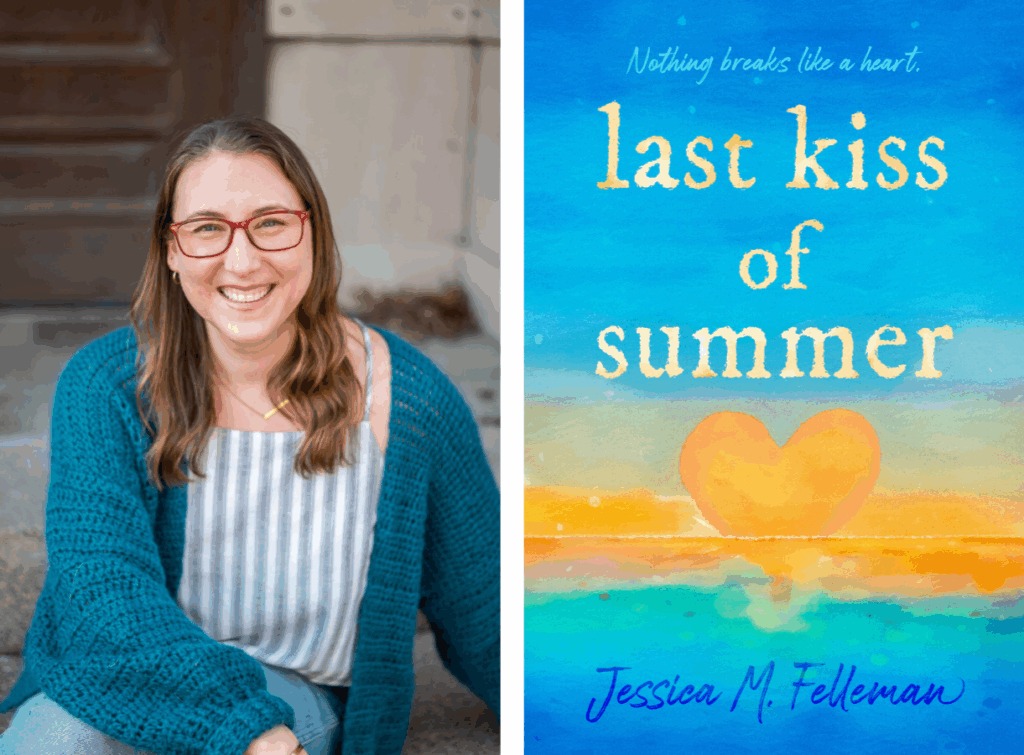
CalArts alum Jessica Felleman (Critical Studies MFA 13) recently released her debut novel, Last Kiss of Summer, a young adult romance centered on Sera Watkins and Luke Tisdale, two teens connected since infancy through a heart transplant procedure that forever intertwines their lives. Set against the backdrop of a Cape Cod summer, the novel follows the pair as they reconnect after years of heartbreak, shared history, and emotional distance.
In conversation with 24700, Felleman, who is also a literary agent, discussed the inspiration behind the novel, the influence of her time at CalArts, and what gives her hope about the future of storytelling.
First off, congratulations on the release of Last Kiss of Summer. How does it feel to finally have the book out in the world and in readers’ hands?
Thank you so much. It feels wild. Very exciting. I think I had a lot of anxieties that, in a weird way, disappeared when I woke up on publication day. That cleared space for me to just be excited that people are reading it at all; that it’s in bookstores; and that I’m getting little messages online from readers. Some are maybe a little angry at me for what I put them through emotionally, but that was the intention. So it’s all good. It’s been really wonderful and it feels like we’re just getting started.
Sera and Luke’s connection through the transplant gives the relationship emotional stakes from the beginning. What sparked that concept for you, and what did the research process look like?
The concept really came from wanting to tell a love story where two people are already so inherently connected and then exploring what happens when romantic love enters the picture in that heightened state.
A lot of the medical aspects were grounded in research. I did a lot of research into heart patient care, transplant statistics, and medical journals. I also spoke with a cardiologist and author, Sherlene Obuobi, to fact-check some of the scenarios in the novel. There were definitely moments where I asked, “If this happened, would this happen?” and she’d say, “Absolutely not.” And I’d say, “Great, thank you. Ignoring that for the sake of fiction.”
What mattered most to me was making sure the emotional and medical realities felt truthful, especially because this is a book aimed at teens. If even one reader learns more about organ donation or decides to become a donor because of the story, that would mean a lot to me.
Summer stories in YA fiction can feel especially emotional because there’s both freedom and this awareness that the moment won’t last forever. Were there books you loved growing up that influenced the atmosphere or emotional tone of the novel?
A lot of the setting was inspired by my own teenage summers spent with my best friend on Martha’s Vineyard and Cape Cod. We were voracious readers, and I still remember these tragic YA love stories we read growing up, even if I can’t always remember the titles now.
I also loved Francesca Lia Block’s Weetzie Bat books, which I reread constantly as a teenager. I actually got to meet her through the literary magazine while I was at CalArts. There’s something about the atmosphere of those books that really stayed with me.
Part of why summer stories appeal to me so much is that, when you’re a teenager, there’s this feeling of freedom and suspended time. You look back on those summers and they feel endless, even if they were really only a few weeks long.
How did your experience in the MFA Writing program at CalArts shape you as a writer?
One of the biggest things I took away from CalArts was not being afraid to try something different. Because the program was so eclectic and the courses weren’t separated strictly into fiction, nonfiction, or poetry, there was space to experiment outside of what I thought I was “good” at writing.
The community was also hugely important. Being surrounded by writers who were committed, thoughtful, and willing to ask hard questions taught me how to be a better reader for other people’s work and how to take feedback constructively.
My thesis mentor was (former CalArts faculty) Steve Erickson, and one of the things that still sticks with me is something he told me: “Nothing’s ever done. You just have to decide when it is.” You could keep editing forever, but eventually you have to let the work go.
Were there any experiences at CalArts that helped prepare you for evaluating other writers’ work professionally as a literary agent?
Through the literary magazine, both Steve Erickson and (also former CalArts faculty) Bruce Bauman noticed that I had enthusiasm for the business side of publishing. Bruce was eventually the one who suggested I consider agenting.
The workshops also helped a lot because you’re learning not just how to critique work, but how to offer reactions and feedback that help guide a writer toward the changes that are right for them. Then with the literary magazine, we were reviewing submissions and thinking about whether a piece fit with what we were trying to do editorially. That all became really useful preparation for agenting.
As both a literary agent and now a debut novelist, what surprised you most about being on the author side of the process?
I realized I’m much more emotionally reactive to edits than I thought I would be. I love my editors and their advice is always right, but it feels different when you know they’re helping shape not just the art itself, but how readers will experience the book.
I was also surprised by how long publishing takes. The book was essentially finished over a year ago, and then suddenly the final week before publication moved incredibly fast.
For CalArts students and emerging writers, what’s giving you hope right now about the future of storytelling and opportunities for new voices?
Something that’s really given me hope is seeing how supportive writing communities can be. I’m part of a group called The 2026 Debuts, and everyone has been incredibly supportive of each other. I always tell writers that other writers are your best community and support system. Rising tides lift all boats.
I think, in the face of all the scary “who knows how AI is going to affect publishing” nonsense, the fact that the writing community has taken a pretty strong stance against it and feels united around that gives me hope too.
I also feel like there’s a growing desire among younger people for nondigital time again, which is great news for people who are writing books for youth.
Last Kiss of Summer is available now wherever books are sold through G.P. Putnam’s Sons Books for Young Readers.